




Late winter offers brighter days and crisp air – but also a dryness that the skin truly feels. As humidity levels drop, the skin needs more care and smarter choices.
Waterless skincare is one such choice. Without diluted water and undesirable preservatives, you get products rich in active ingredients, natural oils, and plant butters that truly deliver. They help lock in moisture, strengthen the skin barrier, and deeply nourish the skin – perfect when the climate is at its most challenging.
See late winter as an opportunity to give your skin some extra love. Small, conscious rituals can make a big difference – allowing your skin to meet spring soft, strong, and radiant. ✨
Why waterless skincare works extra well now
During cold and dry periods, the skin's transepidermal water loss (TEWL) increases. This means that moisture evaporates more quickly from the skin's surface, especially if the skin barrier is already weakened.
Waterless skincare primarily works with lipids – fats that mimic the skin's own building blocks. They:
-
strengthen the barrier function
-
reduce evaporation
-
soften and protect
-
deliver fat-soluble vitamins and antioxidants
Let's take a closer look at some of the most effective raw materials.
Shea Butter – the barrier builder
Shea butter is technically a vegetable fat with an unusually high proportion of so-called unsaponifiable substances (5–10%). It is these components – phytosterols, tocopherols, and triterpenes – that make it more than “just fat.”
Technically:
-
Melts on skin contact (approx. 31–38 °C)
-
Rich in oleic acid and stearic acid
-
Naturally emollient and lightly occlusive (creates a barrier on the skin to seal in moisture and prevent evaporation)
Effect on the skin:
Shea butter strengthens the skin's lipid matrix (a mixture of fatty substances found in the outermost layer of the skin) and has a soothing effect on irritation. It is particularly valuable during late winter when the skin feels tight, red, or flaky.
Cocoa Butter – structure and protection
Cocoa butter has a higher proportion of saturated fatty acids than shea butter, giving it a firmer structure and a more protective feel. We use a large amount of cocoa butter in our wonderful lip balms.
Technically:
-
Higher melting point (34–38 °C)
-
Very oxidation stable - it does not go rancid easily!
-
Provides firmness in salves and balms and gives excellent glide in lip balms
Effect on the skin:
Cocoa butter creates a protective layer that effectively reduces moisture loss. Perfect in lip balms, hand balms, and body butters during dry months.
Beeswax – the natural protection
Beeswax is not just a thickening agent – it is a highly functional barrier builder.
Technically:
-
Contains natural esters and fatty acids
-
Forms a semi-permeable film
-
Stabilizes and thickens formulations
Effect on the skin:
Beeswax locks in moisture without clogging pores. It protects against cold and wind while allowing the skin to "breathe." Therefore, it is common in protective salves for exposed areas. We use beeswax in our lip balms and in our salves.
Vegetable cold-pressed carrier oils – nourishment at a cellular level
Carrier oils serve as vehicles for fat-soluble vitamins and essential fatty acids. Their fatty acid profile determines how they feel and work on the skin. We use several different cold-pressed vegetable oils in our products. Some of our favorites are:
Avocado Oil – repairing and rich
A big favorite of ours. We use organic avocado oil in our face oils and lip balms. Avocado oil is rich in oleic acid and phytosterols. Deeply acting and emollient.
-
Supports dry and mature skin
-
Provides a nourishing sensation
Coconut Oil – protective and antibacterial
We use coconut oil in all our solid soaps. Coconut oil contains a lot of lauric acid. It is not without reason that coconut oil is a very popular oil in body care. It is softening and can be used as is. However, coconut oil should not be used on the face as it can be comedogenic (clog pores and cause blackheads, for example). The molecules in coconut oil are too large to be properly absorbed by the skin.
-
Solid at room temperature
-
Protective and softening
-
Good in body products and salves, but has a low melting point. Can cause lip balms/salves with a lot of coconut to lose consistency on warm summer days or in tropical climates. Can be comedogenic.
Olive Oil – the classic
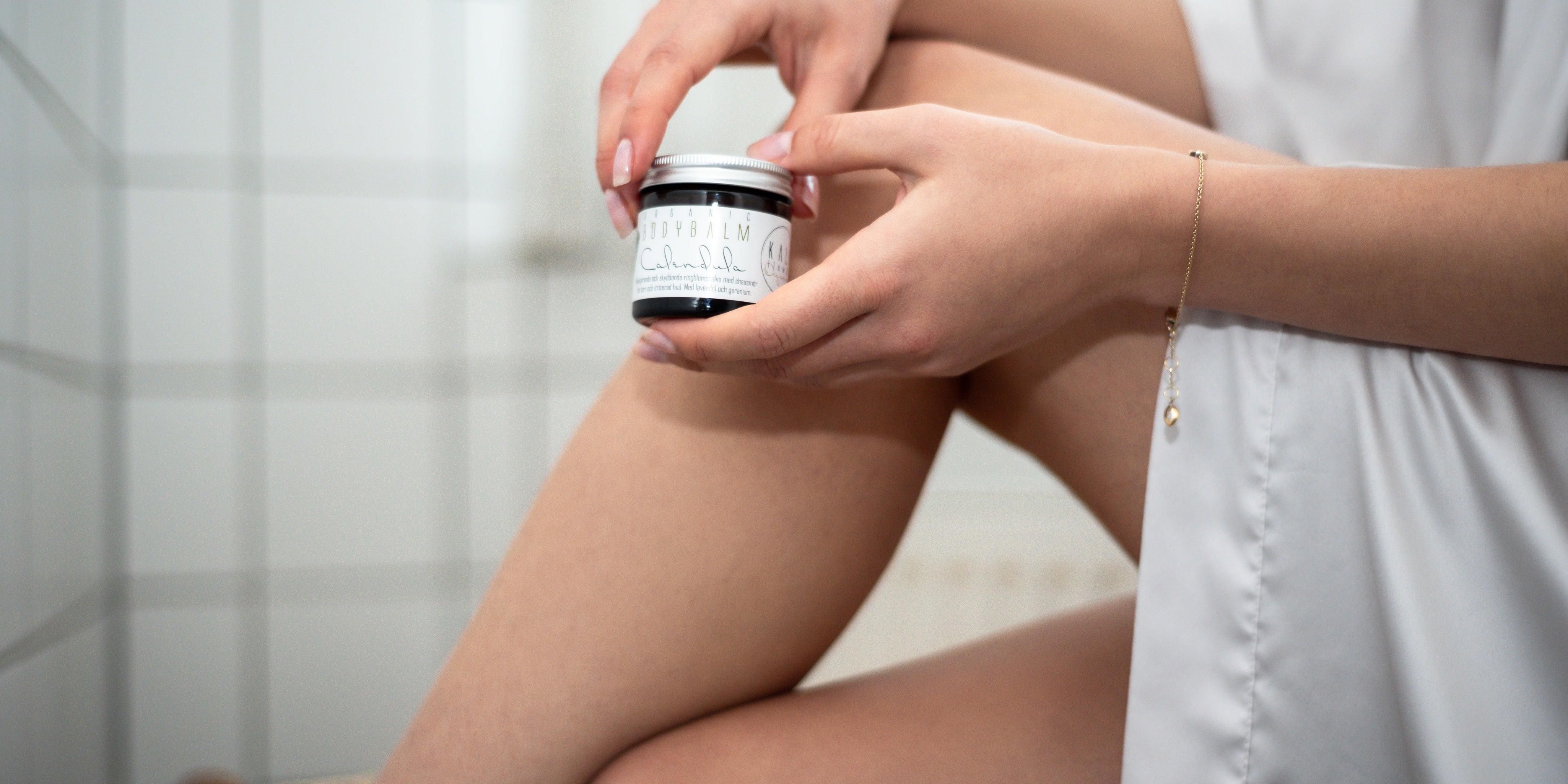
We use a lot of olive oil in our products, including in our Calendula Body Balm and Hand-/Foot Balm Lanolin salves and in our three lip balms. Also, a large part of all our solid soaps is saponified organic cold-pressed olive oil. Olive oil is rich in oleic acid and antioxidants and is one of the fattier oils, making it suitable for dry and eczema-prone skin.
-
Strengthens the lipid barrier
-
Intensely softens
-
Suitable for dry skin
Thistle Oil – light and balancing
Thistle oil has a high content of linoleic acid. It is a light and fast-absorbing oil that we use as a base in our face oils. For the face, we usually don't want oils that are too heavy, but rather something that gives a lot without being greasy.
-
Light and fast-absorbing
-
Strengthens the skin's barrier function
-
Excellent for sensitive or unbalanced skin
Jojoba Oil – the skin's biomimetic balancer
Jojoba oil is not really an oil in the classic sense, but a liquid wax ester. This makes it unique in the world of skincare. Its molecular structure resembles the skin's own sebum more than any other vegetable raw material. We use it in all our face oil serums and in our lip balms.
Technically:
-
Consists mainly of long-chain wax esters
-
Very oxidation stable (rarely goes rancid)
-
Light, silky feel
-
Non-comedogenic for most skin types
Effect on the skin:
Because jojoba oil mimics the skin's natural sebum, it can help balance sebum production – both for dryness and for overproduction. It strengthens the barrier without feeling heavy and absorbs smoothly without leaving a greasy residue. The skin feels like velvet!
In waterless skincare, jojoba oil often acts as a "bridge" between richer butters and lighter oils. It improves spreadability, adds stability to the formulation, and contributes to a soft, supple finish.
During late winter, when the skin's own lipids are under pressure from cold and dry air, squalane can be seen as a way to replenish what the skin itself produces – thereby supporting its natural resilience.
Squalene – the skin's own emollient
Squalene is a natural component of the skin's own sebum. It is a lipid that plays an important role in keeping the skin soft, supple, and protected. In young skin, squalene can make up to 10–15% of the sebum's composition – but levels decrease with age, which partly explains why skin becomes drier over time.
In skincare, the stabilized form, Squalane, is often used, as pure squalene is sensitive to oxidation.
Technically:
-
Light, thin molecular structure
-
Highly skin-compatible (biomimetic lipid)
-
Improves spreadability and absorption in formulations
-
Non-comedogenic for most, i.e., does not clog pores
Effect on the skin:
Squalane acts as an effective emollient – it softens without clogging and strengthens the skin's lipid barrier. Because it mimics the skin's own fats, it integrates smoothly into the barrier's structure and contributes to reduced transepidermal water loss (TEWL).
It provides a silky, almost weightless feel and balances richer ingredients such as shea butter and cocoa butter. In waterless skincare, it often acts as a "texture enhancer" – it makes balms and oils more easily absorbed, spreadable, and less heavy/greasy.
During late winter, when the skin's own lipids are under pressure from cold and dry air, squalane can be seen as a way to replenish what the skin itself produces – and thereby support its natural resilience.
It's all about balance!
A well-formulated waterless product thus combines these three into a finely calibrated product:
-
Plant butters - e.g., shea, cocoa, mango butter contribute structure and deep nourishment
-
Waxes - e.g., beeswax, carnauba wax, rice wax provide protection and moisture sealing
-
Carrier oils - cold-pressed organic for balance and absorption
Together, they create a synergy that both protects and repairs – something the skin truly appreciates when the temperature shifts and humidity is low.
Late winter is a transition period. And just as we change wardrobes, the skin can benefit from changing its strategy.
Choosing waterless skincare is not just a trend – it is a functional, thoughtful way of working with the skin's biology. When you give the skin the right building blocks, it can do the rest itself! Here you can find all our waterless products.
